Showing posts with label Media. Show all posts

Thursday, June 16, 2016

Helping The Hindu in investigating charges of bias


The following article was written for MyInd Makers. Reposting it here for reference.


“Investigating the charges of bias” – screamed the op-ed page headline of The Hindu on March 7th. Just for the impact, look at the picture shown above of the newspaper that day.

The Readers Editor (RE) of The Hindu started a 3-series article on “Investigating the charges of Bias” on The Hindu. The RE is a concept unique only to The Hindu. The office of the RE publishes a “corrections and clarifications” column for 5 days of the week, in which significant errors are rectified. For this, the paper deserves kudos. But this article is not about the functioning of the RE (if you are still keen on that, here are a couple of earlier articles and discussions I had with N.Ram on this).

In this first of the three part series of “investigations”, the RE has taken the side of the newspaper, by citing isolated examples of a few cartoons on all Prime Ministers. The RE tells us that, amongst other queries, he has “…also received letters that said that the cartoons are mostly against Prime Minister Narendra Modi, revealing the ideological slant of the newspaper.” So in order to try to prove this wrong, the Readers Editor has chosen to take solace in the fact that The Hindu did publish cartoon against every Prime Minister.

And here is where, the RE has got the gist of the feedback, fundamentally wrong. I say fundamentally wrong, because it is not a daily occurrence that long time readers of the paper write in expressing their anguish. Fundamentally wrong because, by trying to focus on isolated articles on various governments, the RE (and The Hindu) is trying to duck the charge of being supremely biased against *this* Prime Minister.

Therefore dear RE sir, please allow me to make an attempt to help you in these “investigations”.

First, let us not dig way back into the past. Let’s just focus on the last one month. And allow me to borrow this from a disgruntled reader – “I do not have memories of reading anything other than The Hindu. Of late, in the wake of the JNU debate, I’ve found almost all the guest columns on the editorial/perspective pages to be biased. It is tiring to read about articles…”

The JNU coverage in your paper started on February 13th with the following front page article.


I highlighted the byline – “Arrest follows pro-Afzal slogans on campus”. This is simply not true – in other words, the paper is not giving out the actual slogans that were raised on the campus that day.
Slogans like “Bharat ki barbadi tak jung rahegi”, “Bharat ke tukde tukde karenge”, “Tum kitne Afzal maroge, ghar ghar se Afzal niklega”, “Afzal hum sharminda hai, tere khatil zinda hai” – And no, the last two slogans are not “pro-Afzal” – they are a direct threat to breed more terrorists. So instead of presenting the readers with the true picture, the paper began their campaign in earnest. And the deluge that followed for the next 20 days is what made readers feel “tiring”.

Dear Sir, the charge of bias is because of the following statistics. Almost every single day from Feb 15th, there was at least one article in the op-ed page that repeated only one argument ad-nauseum. Don’t trust me? I am linking them all here for your reference.

  • Feb. 15th - 1, 2, 3 (this is not even an op-ed piece. This opinion was published in the “news” section)
  • Feb 16th – 1, 2, 3 (again, not an op-ed piece. Opinionated headline published in the “news” section)
  • Feb 17th – 1, 2 3 (letter by “eminent professors”)
  • Feb 18th – A break from long op-eds. But a cartoon, and a long list of letters (almost all supporting The Hindu) made up for these!
  • Feb. 19th – 1, 2, 3 (Interview with Umar Khalid’s sister)
  • Feb. 20th – 1, 2 (Cartoon)  
  • Feb. 21st – Sunday’s are holiday for opinion pages. Thank God for small mercies!
  • Feb. 22nd - 1
  • Feb. 23rd - 1
  • Feb. 25th - 1, 2
  • Feb 27th - 1
  • Feb 28th – No mercy on a Sunday. 1
  • And it went on and on
  • March 2nd - 1
  • March 5th - 1
  • March 9th – 1

And these are just articles from the op-ed pages. Remember, the op-ed page articles are long reads, and getting space on them is very difficult. And yet, the paper dedicated space almost every single day to present one-sided views of the issue engulfing the media. Almost every single day, half page of the “news” section, after the op-ed page, had coverage about this JNU incident. Almost every single day. And this is exactly why readers write in saying – “I have been a reader for the last 30 years and this newspaper has stood out for its reporting. But I have seen this trend change and it is not subtle...”

There is not a single article that counters these labored arguments. Not a single article that presents the other side of the story – a side widely accepted in the country. Not a single article that mentions the actual slogans they shouted.

You may retort saying that this is a temporary phenomenon. You may feel that perhaps the newspaper editorial team got carried away by what was happening. But then you also know that these kind of articles are not new – sample this article on Feb 2nd while talking about Rohith Vemula’s suicide. Remember the coverage over Rohith, sir? I remember. And I do not recollect the newspaper mentioning and discussing Rohith’s comments on the chicanery of Sitaram Yechury. In fact, the editorial even told us that we should not take his suicide letter at face value. Or perhaps you should read this long article that analyses his suicide note, without even once mentioning ASA or SFI. And I keep wondering why? Why? Perhaps because of bias? There, I said it – the charge of bias! It is this coverage that is being questioned sir. It is because of this coverage that readers write in saying “…but it does convey the impression of being against Mr. Modi.”

Alright, let’s wean away from these stale topics of intolerance, anti-nationalism etc. Let’s discuss about policy coverage. At this point, I would like to shamelessly plug two of my articles written in MyInd Makers.
  1. A counter point to an op-ed article on Food Security act, and
  2. A factual correction for a grossly mis-leading piece on the National Education Policy.

In fact, I have submitted in writing to you an abridged version of the second article, and you have also forwarded to me the author’s response (which is also put up on his blog) – but I still keep wondering – why was the clarification not published in the newspaper? And while I am wondering, all I can hear is one word – bias.

Perhaps I am boring you with too much of Narendra Modi and the BJP. So let’s move to a lighter topic – Rahul Gandhi! Time for another shameless replug – an article written by me in Niti Central. In this, I try to discuss in detail how The Hindu employs lovey-dovey language to cover the speeches of Rahul Gandhi. This is from July last year, and not something this year. Just so that readers don’t have to click on multiple links, I will paste a collage of various reports, and a few snippets of The Hindu while writing “news”.
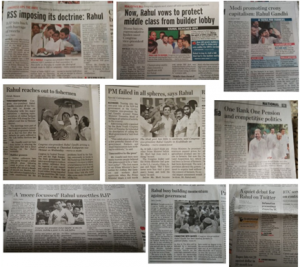

  1. “Championing middle class concerns a significant shift for Rahul”.
  2. “Rahul Gandhi could not have done better in selecting the two issues that had a direct bearing on the State’s economy.” (Remember, this is in a state where his party is in power)
  3. “A more focused Rahul unsettles BJP”

Do you see the pattern now, sir? Not only does the paper spend reams and reams to write against the NDA government, it also dedicates significant space and efforts to prop up the opposition leaders like Rahul Gandhi. Do you hear the scream of “bias” now?

And then there are the small things – on how Kejriwal gets prominent space in the Hyderabad edition; how Kejriwal’s title gains precedence over Arun Jaitley’s; on how Yechury’s rhetoric gets published in the op-ed page, but Arun Jaitley’s response doesn’t; on how the paper tries to tie itself in knots; on how P. Chidambaram’s response gains front page coverage; or when you choose to highlight madrassas over vedic schools.  I can go on and on about these small things, but I think (or I hope) that you get my point about why there is a charge of bias against the paper. And given my hope, I will also not talk about the pre-election coverage of Mr. Modi.

Sir, in your very first article, you have given us a glimpse of what to expect in your next two series, by saying this – “Given the limitations of space, I am restricting my analysis of the cartoons, the editorials, the reportage, and the investigative reports from the days of Indira Gandhi’s prime ministership.”

I’d doubt if anyone is accusing the Hindu of not writing a single article against any other Prime Minister. The charge of bias is because of the consistent negative coverage of *this* government – any small thing that might show *this* government in bad light is prominently highlighted. What else explains the front paging of a report like this?

So for you to pull out a few excerpts from old articles/editorials/investigations related to earlier Prime Ministers will not assuage the feelings of long time readers. There are a couple of articles in the paper that praise Modi too. Just last week, a full page analysis of his foreign policy was published. You know what sir, I almost didn’t read it, thinking it was another tirade!

Please don’t get me wrong sir – because there is nothing wrong in being biased. Being biased essentially means one has made a choice, and can be bold enough to accept the choice. But to claim to be neutral when a barrage of evidence exists against that claim, will only invite a response like this – “The laboured attempt by The Hindu to explain its impartiality is like someone taking a selfie.”

I am an avid reader of the newspaper for more than 20 years now. I recommend the newspaper for students for the science coverage; for the language. And I want to help remove this charge. I hope my references and analysis have helped you a bit in your investigations. I hope your investigations will help this senior citizen change this view of his - “Being an octogenarian reading the paper for decades I have no doubt that The Hindu has veered steadily away from the ideal of fair reporting and contracting views. The anti-Modi stance is glaringly evident…”

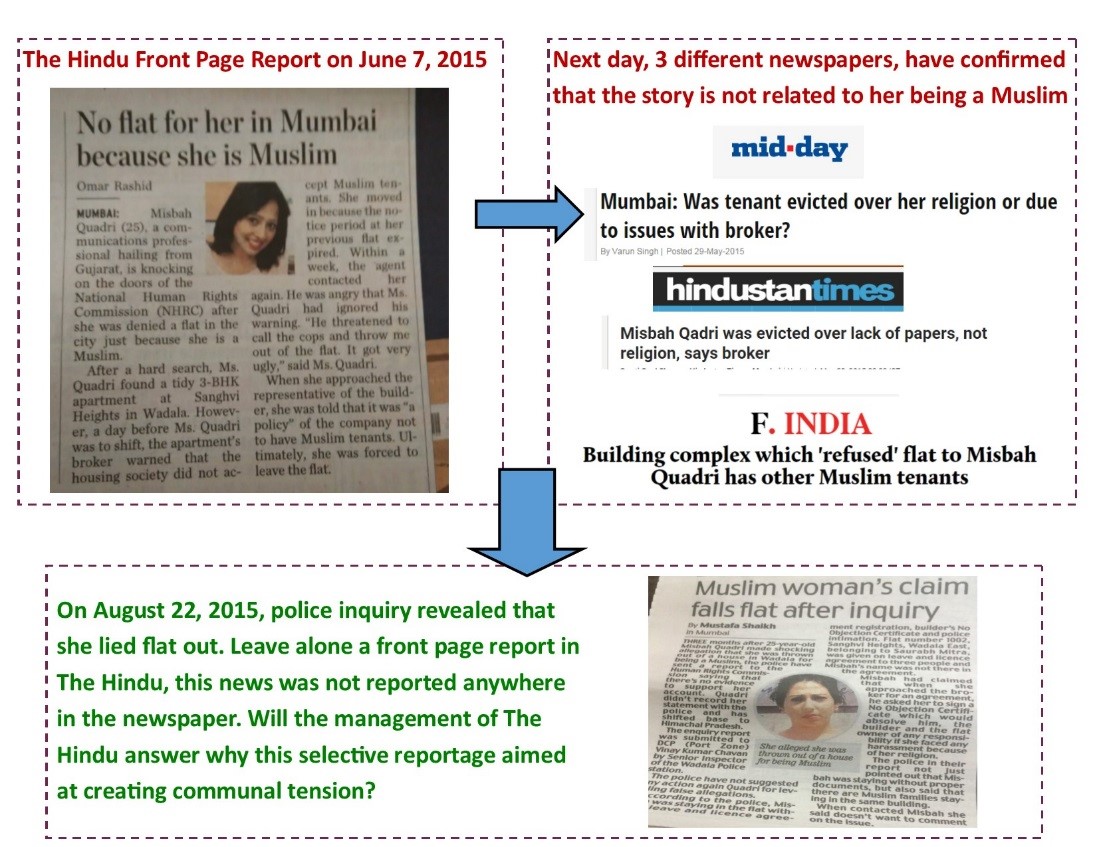
Before I sign off, one last thing Sir – I have even written to you multiple times asking for a clarification on an important topic, which is summarized in the graphic below. If any small run BJP leader would have written something like this, I am sure the paper would have been on the forefront demanding explanations from the Prime Minister. Is it possible to get a response on this please?
- See more at: https://www.myind.net/investigating-charges-bias#.dpuf

The Hindu's inexplicable obsession with Hindutva!


The following article was written for MyInd Makers. Reposting it here, for reference. 


A news item in The Hindu today needs to be included as a case study in Journalism schools. The topic under which it should be included is this - “What to write if you don’t have enough news for the day?”

The article titled “How Twitter helped created Brand Modi” would be so iconic, if it weren’t so comic! First, let’s take a look at this graph above.

The orange symbolizes “Hindutva”. Typically, newspapers like The Hindu use “Hindutva” as a derogatory term; they use it to symbolize the violent elements of the followers of Hinduism. What does the “research group” define Hindutva as? It defines thus:

“Hinduism theme — referring to “Hindutva” or Hindu greetings, practices, festival and gods — was dominant in the first two phases but drops off significantly leading to 2014 general elections.”

If you are still not able to believe what you just read, feel free to read it again. “Hindu greetings, practices, festival and gods” is now Hindutva. I am at a loss of words to challenge this logic. Quite obviously, India celebrates a lot of lot of Hindu festivals, so tweets wishing Indians on festivals would be quite high! To classify his greetings to fellow citizens on festivals they celebrate under the garb of religion is chicanery at its best.

Not just this, the chart gives the vaguest possible definition of each of the other bars. What does “youth” mean? If Modi wished that the youth of India follow the path of Swami Vivekananda, does it fall under “Hindutva” or does it fall under “youth”? This must rank as one of the worst kind of “research” on a politician’s tweets.

And then 2 full paragraphs are dedicated to tell us how many retweets and favorites happen with Modi’s tweets. I mean – is this what serious researchers actually do? I am sure better research happens in the arts department of JNU!

To me, the most important message from this “research” is this – “It was found that the largest category (of people that Modi follows) belonged to laypersons, which constituted 41 per cent of the accounts. Such a behavior is an exception to the rule…”
It is this “exception to the rule” that makes Modi special. It is indeed remarkable that Modi chose to follow “laypersons” (including this author); and it is because of this “exception to the rule” that the sections of the Lutyens Delhi hates him! 

Monday, December 21, 2015

NSA talks and the English media


The following article was written for Niti Central. Pasting it here for reference. 

“Ask original questions please”. Thus pleaded the spokesperson of Ministry of External Affairs, more than once, to the journalists who were merely repeating questions to Sushma Swaraj. That one line summed up the pitiful state of affairs in our media (especially the English language media based out of Delhi).
Sushma Swaraj explained in detail, why Pakistan was deviating from an agreed agenda. She read out the operative part of the Ufa agreement which said that the NSAs of the two countries would meet to “discuss all issues connected to terrorism”. Pakistan Prime Minister signed this agreement – as common sense would suggest, that means he agreed to these talks.
As has been its wont, Pakistan started to add more items to the agenda of the NSA – none of which were either discussed or agreed upon. Sushma Swaraj also clearly mentioned that they are ready for talks on other topics, but not at the NSA level. The NSA level talks must be on terrorism, as agreed upon. Sushma Swaraj was quite emphatic that our NSA cannot talk to Pak’s NSA if the agenda has items other than terrorism.
In such a crystal clear environment, what does the Delhi media understand? Let’s start by looking at this image below. The first tweet is the bottom one, and the latest is the top one.
She first says – “India says, Don’t come if you go beyond terror”. And then asks – Isn’t this in effect India saying that “Don’t come unless you only want to talk terror”. Either she forgot what she heard, or she was trying to sound intelligent by re-phrasing her earlier tweet as a question. It is beyond amusing to note how these people are regarded as some of the top journalists in India!
During the press conference, Nidhi Razdan asks Sushma Swaraj (after she clearly says No talks if they go beyond terror), “So if they don’t respond by day-after-tomorrow, then there will be no talks?” It is precisely this kind of dumbness that invited that appeal from the spokesperson – “Ask original questions please”.
Siddarth Varadarajan went a step further. He went as a guest on a Pakistan TV channel and bashed up the Indian government for having unfair expectations from Pakistan. He asked why the Indian government did not tell Pakistan in Ufa that talks with Hurriyat are not agreeable to India? India already cancelled FS level talks earlier precisely because of this reason – instead of calling out the mind-numbing ignorance of Pakistan, he faults Indian government for not asking Pakistan! And then he says, Pakistan always will want to talk about Kashmir, so India just making a big deal out of it. The genius fails to read the Ufa agreement that clearly says NSA talks will be about terrorism – and this agreement was signed by Pakistan too! Instead of calling out the duplicity of Pakistan in going back on a signed agreement, he is happy at blaming Indian government for trusting Pakistan for the same! It is scary to imagine that he was once a part of some Track-2 dialogue with Pakistan.
Here is the biggest irony – all the three journalists I have mentioned constantly advocate “constructive engagement” with Pakistan, even if Pakistan behaves in the most irrational manner. All the three journalists are also well known to block a lot of people on twitter and are least interested in any “constructive engagement”. It is pretty rich for them to give lectures on “constructive engagement”.
The Hindu’s editorial lists out the sequence of events, that clearly show how Pakistan has been refusing to co-operate with India with regards to the latest round. And then they end the editorial with this line – “There is simply no alternative to talks.” They forgot to mention that Prime Minister Modi has said this many times. They forgot to mention that Sushma Swaraj herself said this many times. We are ready to talk – as agreed let the NSA’s talk about terrorism first. Then we will talk about other topics, including J&K.
The loss is not of India’s as this section of media wants you to believe. The loss is Pakistan’s. Or perhaps the loss is for this section of the media.

Sunday, July 26, 2015

When articles are based on half-baked information


The following article was written for MyIndMakers. Pasting it here for reference:

I opened the Op-Ed page of The Hindu yesterday to read the headline – “Limiting debate to 500 characters” written by Rohit Dhankar.The article began with a sweeping statement “Twitter style conversations cannot build coherent arguments”, referring to the invitation to discuss the New Education Policy. Many tweets since then have “coherently” demolished many verbose arguments of the piece, but that is not the point I wish to discuss here.
As I continued to read, I was aghast at the poor homework by the author and was distressed that drastic conclusions were reached upon based on poor understanding of the working of the participatory website, www.mygov.in. I was amused at how easy it is to get published in main stream papers if you merely criticize this government.
Let’s discuss a few arguments in detail, lest this article doesn’t end up with the same rhetoric. One of the fundamental arguments of the author is about the composition of a mysterious group. First, let me paste parts of his argument here – “MyGov declares that the Ministry has formed a group whose objective, it states, is….”. “ The group that has been formed, though, is a mystery — its members are unknown to the very public that is supposed to give its opinions on the new policy.”
The author goes on to insinuate (in a full paragraph) that the “small chosen group” will decide on the policy. This is where the author (and perhaps the editor) should have done some homework. www.mygov.in is a participatory website that is a brainchild of the Prime Minister. Ordinary citizens (and not just “eminent” citizens) can now merely login to the site, and share their opinions on various facets of governance. To give this some structure, the site classifies various topics and anyone can go and share their view on the topic of his/her interest. A discussion “group” is created for each topic – just like you have groups on facebook, gmail, yahoo, whatsapp etc. The “group” consists of all those who contribute their ideas. So just like there is a New Education Policy Group, there is also an Incredible India group, a Job Creation group etc.
 This therefore begs the question – What kind of fact checking happens at The Hindu before an article is published? The basic  premise of this article is that a “mysterious group” is running the entire show. Did the editors think that no one will access the site to find the truth?
Next, the author cites the 500 character limit in the comments section, and argues that it is often not possible to limit oneself to such a short limit while putting across views on something as serious as education. I found merit in this argument, and visited the New Education Policy discussion page here. I was aghast at what I found. The 500 character limit is surely there, but you can also upload pdf documents, images etc onto this site. A lot of people have done so, and that is how I knew this. This means that I can type up 5 pages worth of my suggestions, create a pdf file for each page, and then upload it onto this site. Or if I have an argument that is 800 characters long, I can type two different messages.
The author equated the 500 character limit to “partly censored opinion generation” (no I am not kidding, the author actually said that!) Therefore this begs the question – who gets to benefit from this half-baked information? Why should the reader be willfully misled by a premium newspaper like The Hindu?
Now that we have shown you the full facts, let’s move over to the opinions expressed in the article further. “By opening up the narrower issues for public debate through predefined themes and leading questions,…”. The author sums up his arguments thus, in the last paragraph of the article. Please visit the New Education Policy group page here. There are 13 themes under School Education, 20 themes under Higher Education. For brevity sake, I am not pasting the 33 topics here, but I would again strongly urge you to visit the page and think if these are “narrow” topics by any chance? These topics cover a wide range of issues under education, if not the full gamut. It is surprising to note that the author found them “narrow”.
What are the arguments that the author makes to substantiate this claim? Sample this – “For example, in one of the questions, opinion is sought on how technology can be used to ensure real-time availability of teachers. The formulation of the question makes it clear that the issue is not whether technology should be used but how it should be used. If the question concerned the ‘whether’ aspect, it would have opened up issues such as trust, autonomy, responsibility and dignity of teachers, all important factors. But by sticking to the ‘how’ aspect, it has already decided that teachers should be strictly monitored and threatened with punishment.”
Anybody remotely familiar with the government schools is very well versed with attendance patterns of the teachers. The author blindly asks the system to “trust” the teachers in being responsible, and not even try to think of penalizing them for transgressions. The author finds fault with the fact that a policy decision of using technology to monitor teachers has already been taken, and the discussion is merely on implementing it. In fact, this is one of his fundamental argument about the MyGov page – “Most questions concern the nitty-gritty of functioning and do not necessarily have much to do with policy.” All I can request is to urge you, the reader to visit the MyGov page and view the topics once again.
Another underlying tone of the article is the offensive manner in which the opinions provided on the group are treated. The author feels that one cannot have “fragemented” views on policy. It has to be “in-depth” only. He also tells us that “Society is being pushed to believe that thinking means throwing in pieces of ideas here and there”. At a few other places, he makes this same point again by choosing different words.
Another example – “While contrasting views are a sign of a healthy democracy, they still need logic and arrangement — in other words, a reasoned argument — if they are to be useful for the purpose of a broad-based discussion on education.”
So, just for fun, I went to the discussion page for the Theme – “New Knowledge, pedagogies and approaches for teaching of Science, Maths and Technology in School Education to improve learning outcomes of Students”
At the time of writing this article, the first response on this page is from a user ID “Amnesty International India”. The user uploaded a pdf document here. There is not a single usage of the words - Science, Maths or Technology – in their opinion on Science, Maths and Technology! A couple of opinions I found interesting, given by ordinary folks. Please go through the link for many more suggestions.
The very idea of MyGov is this – if you have only two ideas that you will think will benefit education, please share them with the government. You do not need to be an “intellectual” to reel out ideas on reforms. Anyone who has a stake in education which is practically every citizen must be given opportunity to contribute.
The author also worries about the “lack of consensus”. Which policy in the world has been evolved out of a consensus of all their stake holders?  Not only is the article based on false premises, the author does not give a concrete suggestion towards policy making in education. There is a lot of rhetoric that flows in, like “education for democracy and social justice.”  Of course what is an article without the customary reference to “aligning education with a certain perspective of Indian culture and history. This lays emphasis on enlarging the space in curriculum for Hindu heroes, scriptures and practices”.
Our mainstream media has restricted the debates around education to history in text books and civic values alone. For the first time, the debate has been opened up to encompass various other facets of education. If this causes heart-burn amongst the liberals, so be it. 
PS: The author responded to my two questions on the facts that misled the readers here: http://rohitdhankar.com/2015/07/23/limiting-debate-some-clarifications-and-responses/