Saturday, February 8, 2020

Has Rajdeep Sardesai lost it? His recent piece on BJP and PM Narendra Modi seems to suggest so.


The following article was written for MyInd Makers. Pasting it here for reference:

Rajdeep Sardesai has lost his mind. I have no qualms in making this drastic statement. Especially after reading his cover story in the latest edition of India Today.
He starts of with imagining that in the year 2029, Modi wins his 4th term in an election. Modi will then introduce the Presidential form of government in India. Modi will then go on to become the President of India. India will become an unofficial Hindu republic because the word “Secularism” will be removed from the constitution. Modi will then face a revolt in the country because he became the powerful President of India. And because of the revolt, the powerful President that Modi is, he will immediately resign as President of India and hold elections to the Parliament of India.
And then Rajdeep very innocently asks us - Fantasy? Yes. Totally unimaginable? No.
So now let’s go back to the opening statement of this article – Rajdeep Sardesai has lost his mind. Fantasy? No. Totally unimaginable? Absolutely not!
His justification for this senile imagination? At the end of 2009, no one thought Modi would be where he is today. In his own words – “How wrong the political pundits were: the white-bearded regional boss of 2009 is the 2019 unquestioned Big Boss of Indian politics”. I love it when this group inflicts so much self- praise on themselves. In this case, calling himself a political pundit! Rajdeep very well knows that there was already a campaign underway by the not-so-political-pundits to announce Modi as PM candidate of the BJP, by the end of 2009 itself! Merely because the ilk of Rajdeep were merrily sleeping behind the wheel, doesn’t mean he gets to fancy weird imaginations!
Rajdeep’s fear mongering doesn’t merely stop here. He predicts that by 2024, “lines between state and religion would be totally blurred”. Not just that, he further emphatically announces that “Minority institutes will be denied state funding”. What exactly is the basis for this fear mongering by Rajdeep Sardesai? Has a single minority institute been denied any funding so far in the past 5.5 years merely because they are minority institutions? Does Rajdeep have any data to back his preposterous predictions?
By 2029, Rajdeep then predicts that “The north-south divide further widens in the course of a decade of confrontational politics.” The alleged north-south divide was first perpetrated by this dangerous ilk in 2017. The Wire carried out a lie filled filthy piece which has been countered in detail on this very site. The English media was hell bent on finding out isolated instances of “Hindi imposition” to create a further rift. The people of India gave a resounding slap to all these forces in the 2019 Parliamentary elections.
Yet, the senile Rajdeep doesn’t stop his crazy imagination. He predicts that CMs of “atleast 4 southern states” will “demand a referendum on the unilateral declaration of a Presidential system by the BJP”. I wonder where he gets such a pathetic vision for his country from. On what basis is this low-life Rajdeep Sardesai predicting that our country will slip into an anarchy and dictatorship? Prime Minister Narendra Modi has won two elections fair and square. Why does Rajdeep hate democracy so much when it doesn’t go his way?
What does he actually mean when he says that “The Supreme Court may have surrendered its magisterial autonomy.”? Does he expect the Supreme Court of India to be at his beck and call on every issue? Why doesn’t he take responsibility for his oft-repeated assertion that “The media may have lost its moral compass.”? Rajdeep has been corrected innumerable number of times on innumerable number of issues. Yet, he goes about spreading his lie-infested and hate-filled journalism. Why can’t he have a moral compass in the first place?
Parliament sessions have been showing record productivity since 2014. Many debates have happened on multiple laws and issues in the House. In addition, many committees have had detailed debates before finalizing the various laws of the country. Yet, the senile Rajdeep Sardesai asserts that “Parliament may have been reduced to a notice-board.” Is it the Parliament’s fault that Rajdeep Sardesai doesn’t follow the proceedings, and yet goes about making random assertions and predictions?
Another random prediction that Rajdeep makes is that in 2029 “Instead, it is civil society groups who have come together to warn against autocratic tendencies: large street protests have been ruthlessly crushed by a police state…”. Very cleverly he is alluding to the police action on violent protestors in 2019. Very cunningly, he is also trying to tell us that the “street protests” were peaceful and it was the police that overreacted. I wonder for how long does Rajdeep Sardesai want to suppress information? In today’s digital day and age, how does he actually think that people like him can suppress information, lie and get away with it?
His hate-filled article accompanied with an equally hate filled image is simply reinforcing the belief that this ilk would stoop to any low. By comparing anything and everything to the excesses of Emergency or the murder by the Nazis, this ilk is doing grave injustice to the sufferers of both these events. This ilk has no sense of proportion when it comes to spreading hatred and fear. It is unfortunate that they still have the reach to write gibberish and get published.
Perhaps a good prediction for 2029 would be that we have an English media that is responsible and doesn’t spread lies. In Rajdeep’s own words - Fantasy? Yes. Totally unimaginable? No.

This Hindu Op-Ed willfully misrepresents what the Kashmiri Pandits had to face in 1990


The following article was written for MyInd Makers. Pasting it here for reference

“What’s wrong with deep humiliation” screamed the op-ed headline in The Hindu.
I couldn’t help but wonder why anyone would even want to discuss or debate what is wrong with humiliation! I mean, isn’t it humiliating enough to discuss why humiliation is wrong?! It stuck to me that this is The Hindu and perhaps there is an ulterior motive in this.
The article largely revolves around rhetoric on Dalits and African-Americans. And then the ulterior motive hits you. And it hits you hard. Because we are told that “The expulsion of Kashmiri Pandits from the Valley was grossly unjust.”
Expulsion, dear The Hindu? Expulsion? Expulsion is when a teacher asks a student to stand outside the class. Humiliation is when you assume your reader needs a lecture on why it is wrong to humiliate. Neither of these adjectives remotely qualify to explain what the Kashmir Pandits have gone through.
Because Kashmir Pandits were murdered. In cold blood. You know it, and yet would not even care to acknowledge it. They were dragged from their homes and murdered. Journalists performing their duty were shot dead merely because they were Kashmir Pandits. Not humiliated, not expelled, but murdered.
Because Kashmir Pandits were threatened. Through public announcements from the speakers of Mosques. Through phone calls to their homes.  By terrorists with weapons. Threatened to either leave, convert or get murdered. Not humiliated, not expelled, but threatened.
Because Kashmir Pandits had to undergo the most traumatic experience of watching their loved ones killed brutally right in front of their eyes. Right in front of their eyes. The scar from the trauma, and not from humiliation or expulsion, never goes away.   
Of course, you know all this. Because you and your ilk conspired to NOT tell us their story. For years together. I didn’t even know such a carnage happened right here in our country. The surviving Kashmiri Pandits had to further live in the ignominy that their story wasn’t being heard or written about.
And you could get the heart to term this murder, this threat, this trauma, this conspiracy as just an “expulsion”? And to rub salt on these deep wounds, you also have the gall to tell us that this is “grossly unjust”? Grossly unjust is when a supermarket guy cheats you with a weighing scale. Grisly murder doesn’t qualify as being “grossly unjust”. Ghastly threats don’t qualify as being “grossly unjust”. If there is anything “grossly unjust”, then it is the very choice of the phrase!
Do you want to know further what is “grossly unjust”? You telling us that “Ways must be found to bring them back to the Valley, and to reconcile communities.” Oh, how so sweet of you! If you hadn’t given us this phenomenal piece of advice, us ordinary souls wouldn’t even thought about this. You could have redeemed yourself by dwelling more into what are the different “ways to bring them back to the valley”.
Instead what do you do? Humiliate the survivors further. How? By telling us that “But, the dismembering of the state of Jammu and Kashmir is also seen by many Kashmiris as humiliating.” At this point, words fail me. Did you really compare the reorganization of a state to murder? Did you actually use the word “dismember” and not in the context of the actual dismembering of many Kashmir Pandits on that fateful January in 1990?
How low of you to compare an event where no lives were lost, to the ghastly crime of murder and carnage?  It is already humiliating that your ilk has kept away this story from us for such a long time. What prompts you to add further fuel to it?
Perhaps you did realise how pathetic your comparison was. And that’s why you told us in the very next line that “Now, there is nothing humiliating per se in the rearrangement of a State into different administrative units.” How very noble of you. But if you were really serious about it, you wouldn’t have made the comment in the first place. And your very next line confirms your small-minded thought process. You ask us - “But when accompanied by gloating and triumphalism, does it not border on wilful humiliation?”
You know what - It is your article that amounts to “willful humiliation”. Not just to the Kashmir Pandits. But to the very Dalits and African-American community you refer to for most part of your article. To trivialize their travails and to compare their trauma to an event in which there was NO loss of life, simply exposes the depths to which you will plunge to. The story of Kashmir Pandits would have died a natural death if not for the internet and social media.
I grew up reading The Hindu and I have never known the story of Kashmir Pandits until the Internet ear dawned upon us. Only after the Social media era began is when I came to know the ghastly details of that carnage in January 1990. This deadly conspiracy to keep this story from reaching the country is simply unbelievable. And even in this age of information, The Hindu thought it could get away with merely terming the entire saga as a “grossly unjust expulsion”. Nothing can be more humiliating than that!

While the ghost of ‘spirit of constitution’ haunts again, here is how it was murdered and buried in Karnataka post May 2018


The following article was written for OpIndia. Pasting it here for refernce

You might be wondering why I am writing about Karnataka at a time when there is so much drama happening in Maharashtra! “Spirit of the Constitution” is the buzz phrase these days and is being only applied to the BJP in Maharashtra. This set me thinking on what a good example would be to discuss more in detail about “spirit of the constitution”. Turns out, Karnataka, post-May 2018 is the perfect example of discussing this.
The Congress party was ruling Karnataka at the time of going to elections in May 2018. The people of Karnataka booted the Congress party out of power– the verdict was unambiguous on that front. The ambiguity of the verdict lay in the fact that no single party got a simple majority. The BJP fell short of just 8 seats of a simple majority. The BJP emerged as the single largest party with 104 seats. And JD(S) party ended up with 37 seats.
Innumerable precedents and “spirit of constitution” demanded that the single largest be called for forming of the government. The Congress party, which was rejected by the people of Karnataka announced support to the also-ran JD(S). Combinedly, they had the necessary numbers for forming the government in Karnataka. Someone, please explain to me how the coming together of two rejected parties is in the “spirit of the constitution”? Someone, please point to me all the different editorial and op-eds that call out this chicanery of the Congress party?
Once Supreme Court ordered for an immediate floor test, Yediyurappa resigned. And a Cong-JD(S) government was formed in direct contradiction to the “spirit of the constitution”. Yet, we had media celebrating the fact that all opposition parties have come together on one stage. And were also busy berating the BJP for having an obsession for power!
While in power, the Chief Minister H.D.Kumaraswamy literally cried once saying that he is swallowing poison (referring to the troubles the Congress party was creating for him), and has bemoaned multiple times the problems he is facing. What “spirit of Constitution” allows an alliance partner to make the leader of the alliance literally cry in anguish?
The people of Karnataka gave a very resounding verdict in favour of the BJP and against the JD(S)-Congress alliance in the 2019 LS elections. The people were the ones who actually upheld the “spirit of the constitution”. Quite expectedly, these results resulted in churn in the JD(S) and the Congress party. MLAs had begun to rebel, at which point the English media got activated again. Messages were flowing left and right on how the BJP is “poaching” MLAs.
Under these circumstances, what is the right thing to do? 1. The rebel MLAs should resign, go back to the people explaining why they did it, and seek their verdict again. Or 2. The rebel MLAs don’t resign, change party affiliation and then enjoy power?
There will be an overwhelming consensus on Option 1. There will also be an overwhelming consensus that (1) never happens and (2) often happens. So when MLAs opt for (1), they are obviously upholding the “spirit of the constitution”. This is exactly what the 17 MLAs who rebelled did. They resigned.
We were all witness to the efforts Congress made to get back these MLAs to their fold. Upon failing to do so, the Speaker of the Karnataka Assembly disqualified the 17 MLAs citing defection! Instead of accepting their resignations, the Speaker decides to disqualify them. “Spirit of Constitution” indeed. Not only that, he disqualifies them for even contesting elections till 2023! No Speaker has this power – of disqualifying citizens from contesting elections on any pretext. Yet, we did not see opinions on how the “spirit of Constitution” was being destroyed by the Congress party.
With the Assembly short of 17 members, the BJP obviously has a majority. Rightfully, they were called to form the government which they did. The disqualified MLAs went to the Supreme Court, which upheld their contention that they cannot be disqualified from contesting elections.
So let’s summarize this now. Two highest courts of the land – the people’s court and the Supreme Court – have both slapped the Congress party hard. Both did so, for violating the “spirit of constitution” and the letter of the constitution. On multiple counts. Karnataka is the best example of how one party upheld the “spirit of constitution” to the fullest and how one party abused the same. Yet the English media never highlights this abuse by the Congress party.
The by-polls for these 17 seats are scheduled on the 4th of December. The people are supreme and will speak again. If they give BJP the requisite majority, we will perhaps again see articles on how “money power” played a role in them winning!

The Hindu and Sonia Gandhi’s NAC member Jean Dreze join hands to spread lies about Modi govt’s maternity schemes


The following article was written for OpIndia. Pasting it here for reference

“Maternity scheme reaches only one-third of beneficiaries”, screamed a headline in The Hindu today. One-third = 33% in normal parlance. And right in the middle of that story, The Hindu puts a graph. The graph tells us “Only about 61% of mothers enrolled received their total entitlement of INR 6000”.

Article in The Hindu

  • Jean Dreze estimates that the annual number of births in India is = 270 lakhs (2.7 crores)
  • Jean Dreze then tells us that a “little less than half would be first births.”
  • The report tells us that “a little less than half” = 123 lakhs (1.2 crores) first births.
  • Both Jean Dreze’s op-ed and the article tell us that the Maternity scheme, Pradhan Mantri Matru Vandana Yojana, is intended to benefit all the 1.2 crore mothers!
  • And in this 1.2 crores, the government was only able to reach a paltry 60 lakh mothers.
  • Voila, the scheme has reached only 60 lakh mother (50%). Full instalments paid to only 38 lakhs (31%).
  • More than 90% of the mothers who enrolled for this scheme have received at least 1 instalment so far.
  • More than 60% of the mothers who enrolled for this scheme have received *all three*installments so far.
  • The Hindu provided a platform to dubious number extrapolators only to show the Narendra Modi government in a bad light.

It is therefore quite natural for one to get curious to understand if the headline is dubious or the graph is. So I read the whole story, but I was further confused. Because the report uses many numbers (perhaps to confuse the reader). For example, they write that the “scheme failed to reach at least 49% of all mothers who would have delivered their first child”, and therefore “the scheme was able to benefit only 31% of its intended beneficiaries”.
Enter Jean Dreze, the famed member of Sonia Gandhi’s NAC, to help clear this confusion. The Hindu published an op-ed by Jean Dreze today itself– “The mother of non-issues”.
This op-ed article expands vastly on the study, graph and dubious headline of the earlier article. Let me summarize the numbers presented in both articles so that we get clarity on the dubious headlines.
It didn’t occur to both the eminences writing the articles and the editors editing the articles that all the 1.2 crore mothers in the country would not be eligible for the scheme? I wonder why John Dreze and his ilk want the government of India to give Rs. 6000/- to mothers who can afford and get good medical care?
Without even reading through the central government notification, I could easily tell that this scheme will be applicable to poor families only. A cursory reading of the guidelines of the ministry already tells us that both state and central government employees aren’t eligible for this scheme. In the two years that this scheme was implemented, it has reached 80 lakh mothers already!
The PMMVY scheme provides assistance of INR 2000 in three instalments. The scheme is primarily aimed at “Providing partial compensation for the wage loss in terms of cash incentive s so that the woman can take adequate rest before and after delivery of the first living child”. So in case, the baby is stillborn after the mother receives the first instalment, she is still eligible for the second and third instalment the next time she gets pregnant.
With all this information at hand, the truth is this:
  1. More than 90% of the mothers who enrolled for this scheme have received at least 1 instalment so far.
  2. More than 60% of the mothers who enrolled for this scheme have received *all three*installments so far.
  3. The Hindu provided a platform to dubious number extrapolators only to show the Narendra Modi government in a bad light.
These dubious extrapolators were called “researchers” and “development economists” by The Hindu. These “researchers don’t stop here. We are told by them that “Given the stipulated conditions, the scheme brings under its ambit 23% of all births and pays full benefits to a mere 14% of all births”.

Now, it is but natural for you to think if INR 6000/- is enough support. Of course not. That’s why we have “Pradhan Mantri Surakshit Matritva Abhiyan” which provides “timely and quality antenatal care, free of cost, universally to all pregnant women on the 9th of every month.” Free of cost. That’s why we have free health screening camps at Anganwadi centres twice a year. That’s why we have Anganwadi centres in the first place too! We also have a “Rajiv Gandhi National Creche Scheme” for working mothers!
The PMMVY scheme, that has been central to these two articles today, is solely aimed at providing financial assistance for firstborns only. The scheme, as intended, is reaching out to the beneficiaries. Jean Dreze complains about having to submit Aadhar details –“Aside from filling a long-form for each instalment, women have to submit a series of documents” He conveniently forgets that the linking of Aadhar has helped in the elimination of corruption at the middle-men levels! It is really amusing to see this ilk often complaining about the need to link Aadhar as the rightful means for beneficiaries to get their money!
While Jean Dreze is upset that this amount still isn’t in line with what he proposed in the Food Security Act, I love the ending paragraph of his op-ed though. He tells us that Odisha government’s scheme (Mamata) is awesome because – “88% of those eligible for Mamata benefits had applied, and 75% had received at least one of the two instalments.” If it’s awesome that Odisha could reach 75%, what adjective should we use for Government of India, which has reached >90% of the intended beneficiaries?.

Book Review: Rajneeti - A great insight into one of the most underrated politicians in India


The following article was written for MyInd Makers. Pasting it here for reference

My heart was getting heavier with each line, as I was reading through the plight of a 24 year old Physics teacher and a district level leader from Mirzapur. He was arrested on 12th July 1975, because he was organizing many meetings to campaign against the dreaded emergency imposed on the country by Indira Gandhi. Both his mother and wife had come to a railway station through which his train was passing, to catch a glimpse of him but couldn’t get to speak of him because of the police presence there.
The mother waited and waited for her son to come back home. The mother had told him in no uncertain terms not to compromise on the truth. With uncertainty looming, the mother had suffered a stroke and eventually passed away. The son chose not to apply for special permission to visit his ailing mother. The son completed post-death rituals in the jail itself. Yet the son stood like a rock, making his mother very proud.
This poignant story made my think about the stories of many such mothers and sons which have been kept away from us for many years. Those who today loosely use the word “emergency” today have truly not felt an iota of what an actual emergency looks like. For starters, can they even imagine the commitment and strength of a 24 year old well established Physics teacher to have braved an arrest, not knowing when he will be released or if he will even be released from jail? 
The son and the Physics teacher we are talking about is today India’s Defense Minister, Rajnath Singh. Despite the volume of information available on him, this was for the first time that I got to read about his exemplary commitment during such harrowing times. And for that, we have to thank Gautam Chintamani for writing the book “Rajneeti – A biography of Rajnath Singh”.
I actually have to thank Aashish Chandorkar for writing about this book, because only after reading the review on Indic Today, I went ahead and purchased it. Ashish is indeed right – “Contemporary History is a rare genre in Indian History”. Perhaps it is rare because it has so far been focused on very few individuals. Students of political history would be yearning for books like Rajneeti, to get more insights into the functioning of leaders who have been instrumental in the shaping of many historical events.
The initial chapters of the book focus less on Rajnath Singh and more on events that have led to the birth and rise of the Jan Sangh and later the BJP. Intertwined in these narratives is the rise of Rajnath Singh too, from being the son of a farmer (who resisted massive pressure to contest election) to becoming the education minister of Uttar Pradesh.
And from these chapters onwards, the book is a fascinating read that gives great details on the many good things Rajnath Singh had implemented. For example, today’s media would have highlighted Rajnath Singh’s short tenure as UP’s education minister with a dramatic headline - “Pass percentage dips in UP from 57% to 15%”. They would have never told us that this drop was because of a stringent Anti-Copying Act that Rajnath Singh had implemented, despite huge pressure on him not to do so! Imagine – we’ve had to wait till 1992 to have a minister stand up and tell that rampant copying is actually spoiling the future of children!
The further rise of BJP and internal politics in UP meant that Rajnath Singh will take up a ministerial post in Vajpayee-led NDA government. After detailing some of his achievements here, the book gives us very fascinating details on how he went on to become the Chief Minister of Uttar Pradesh in the year 2000. The intrigue and mystery of politics is ever so evident in how the events unfolded and more importantly, were superbly captured in the book. Rajnath Singh’s short tenure as UP CM ended in the year 2002. He became India’s Agriculture Minister later during that year and that short tenure ended in 2004! I’d strongly recommend reading the book to understand the work he has done in various capacities in the short tenures he helmed them.
Up until this point of time, every single tenure of Rajnath Singh’s office was a short one! Until he became the President of the BJP for a full term, he actually never completed a full term in any office. Rajnath Singh was the President of the party through one of its most turbulent phase – 2005 to 2009. Whilst the party was able to recuperate and win some state elections, it took a severe beating at the hustings in the 2009 Lok Sabha elections. However, Rajnath Singh came back as Party President in 2012, and was yet again leading the party through another turbulent yet assertive phase. The book details extremely well the happenings in the BJP during both these phases, and especially the 2012 to 2014 phase, where Rajnath Singh’s political acumen ensured that Narendra Modi was declared the party’s Prime Ministerial candidate.
The turbulent UPA years of 2004 to 2014 saw many terrorist attacks in the country. So when the Modi government took charge in 2014, the most pressing issue facing the country was internal security. 2014 to 2019 was also the phase when India’s internal security saw its biggest overhaul. The result - not a single terrorist attack on civilians in the entire country (except J&K). Rajnath Singh was the Home Minister of India during this phase, and it befits his stature that his exemplary work has been documented in such an exemplary fashion.
One of the most iconic images in the aftermath of the dastardly Pulwama attack is the Home Minister of India, Rajnath Singh, holding the coffin of one of the martyrs. This poignant action told the world how serious we are about this attack and rightfully forms the back cover of the book too.
Physics Teacher. UP Education Minister. UP Chief Minister. Agricultural Minister of India. President of BJP. Home Minister of India. Defense Minister of India. This is a resume that many politicians would die for. Gautam Chintamani’s book “Rajneeti” describes in great detail how difficult it is to build such an impressive resume. For all those interested in politics, policy, and public affairs, this book is a great read indeed.

The TOI interview of Abhijit Banerjee and Esther Duflo was more about their views of the Indian government and less about their body of work


The following article was written for MyInd Makers. Pasting it here for reference.

When it was announced that Abhijit Banerjee is one of the three recipients of 2019 Nobel Prize for Economics, there were a spurt of tweets and opinions on how the designer of NYAY had won the Nobel Prize for economics. I was a little put off by this commentary because the man had just won the Nobel Prize and to reduce his body of work to just one program that was poorly designed (and communicated) seemed unfair.
And then on Saturday, October 19th, there was a full page interview published in the Times of India. The interview was of the couple, Abhijit Banerjee and Esther Duflo, who had jointly won the Nobel along with Michael Kremer. The very second question of the interview was spell-bounding – “Do you think the Indian government will take you more seriously now?”. Spell-bounding because there is no evidence that they have either been taken or not taken seriously till now!
As the interview progressed, Abhijit’s view on Jan Dhan Yojana – “we don’t know how much initiatives like Jan Dhan will actually enrich people” – was totally underwhelming. Underwhelming because one wouldn’t expect to read such a naïve statement from a Nobel prize winner! That too, after the Jan Dhan accounts have deposits greater than INR 1,00,000/- crores! That too, after the Jan Dhan had proved that the menace of the middleman corruption has been tackled most effectively. Elsewhere in the interview, Abhijit mentions that “the best thing to do is to put money in the hands of the poor”. Jan Dhan had precisely done that, and here we have a Nobel Prize winner telling us “we don’t know” the impact? What should the reader therefore infer from this?
Furthering such surreal thoughts, we also come to know that he thinks that even a 43% tax is low and this can increase much higher! He tells us that historically taxes for the rich have been as high as 70% and 90% too and “Somehow we have forgotten about all that and are conned into believing that there is no possibility of having tax rates over 40% without a massive disaster happening.” Imagine a 70% tax or even a 90% tax just because you have high intellectual capabilities to provide livelihood to thousands of people! Is this the kind of “equality” we want to achieve in today’s world? Imagine paying 43% tax and getting to drive on horrible roads, pathetic health care and no social security net. Instead of economists proposing ways around this, we now have Nobel Prize winners spewing hatred against the very same people who provide for the livelihood of crores of citizens.
The disdain towards “corporates” is something that I have never understood. Why are they often portrayed as villains of the society when they actually ought to be hailed as heroes? Sure, there are bad apples, but which profession doesn’t have them? How can a corporate tax cut during times of slowdown not be viewed as a positive measure? And what is the alternative proposed by the Nobel Prize winner – “the best thing to do is to put money in the hands of the poor, the economy will revive and the corporate sector will start investing once they see that.” Now, come on! This is rhetoric that you would expect ordinary people to talk about, not Nobel Prize winners! What does “put money in the hands of the poor” mean? Give it to them for free, or provide them employment? Many subsidies and programs are already run by various governments to provide for the poor. In addition to this, various avenues for employment opportunities have been created, especially in the last 5 years – why couldn’t they speak more about this?
 “We missed that bus, and Bangladesh picked it up”. This comment was in response to a question on whether China is more pro-poor than India (Indian media’s fascination with China is another thing of course!). The Nobel winner’s argument was that China invested in the “labor-intensive” manufacturing sector and Bangladesh picked it up. I totally get the missing the manufacturing bus part of the argument, but Bangladesh picking it up is what confused me! In addition, shouldn’t due credit then be given to the Modi government for identifying this problem early in its tenure and focusing on “Make in India” (which by the way is showing significant results?).
Indian media’s obsession with politics while talking to economists is also very fascinating. The Nobel Prize winners are asked “What worries you more - the economic slowdown or the move to majoritarianism.” First of all, neither is this the first time there has been a slower than expected growth nor will it be the last time. And secondly, what does “the move to majoritarianism” even mean?!
While Abhijit’s answer is yet again underwhelming (because it insults the voter) – “the danger is that since the government can't sell the economic message, there are other messages to sell to win elections”, I’d urge you to read Esther Duflo’s answer in full (snippet here) – “It is not an India-specific problem. The slowdown is not just in India, it's also in China. There are also fears of recession in the US and Europe.”
Infact, a lot of Esther’s answers made for better reading than Abhijit’s answers. At various places, we are constantly reminded that economics is a very fluid field and it is very difficult to make any correlations based on the extensive data available too! And yet within those limitations many economists work to suggest the best possible ways for a better society.
Many answers were focused on the present; many answers also indicated that many pro-poor programs are actually working (“We have so many less poor, and that's a positive”), even if they don’t like some things like the “real estate boom”. The views on income and taxation were really underwhelming. There are many positive aspects mentioned in the interview that are headline worthy than NYAY.
The interview would have been really good if more focus was on their entire body of work with more examples of successes these people have encountered in implementing their ideas, instead of commenting on ideas of governments! Afterall, they won the Nobel Prize – surely we will be enriched by knowing more about how their ideas have helped the society.

Pallavi Ghosh outdoes herself, suggests that Rahul Gandhi is planning a coup against Sonia’s leadership


The following article was written for TFI Post. Pasting it here for reference:

Journalist Pallavi Ghosh’s legendary support of the Congress party in general and Rahul Gandhi in particular is quite well known. But I never thought a day would really come when Pallavi Ghosh will outdo herself in her legendary skills. While twitter was abuzz with how Rahul Gandhi took yet another flight to Bangkok, merely days before crucial elections in Maharashtra and Haryana, Pallavi Ghosh enlightened us with a totally new and unprecedented angle – that Rahul Gandhi was planning a coup by meditating in Cambodia!
Don’t believe me? Then you must see her article titled “Congress Coup in the Works? Rahul Gandhi’s Meditation in Cambodia May be Masterplan for His Second Innings”. And no, this is not a satirical piece. It is as serious as it gets. 
A pre-cursor to this exemplary analysis is this news item printed in The Hindu on October 5th, 2019. We have been introduced to a totally new dimension of the Congress party – Team Sonia and Team Rahul aren’t getting along together! Am amazed at the capacity of the mighty Congress party to write these jokes!
Congress, Pallavi Ghosh

Pallavi Ghosh adds yet another dimension to this angle – Sonia Gandhi herself wants to see her son become Congress President again and is aiding him in planning a coup against her! This is not my interpretation of her article, but this is her own conclusion – “Sonia Gandhi wants a second coming for her son but this time, the coup will be from within, possibly nudged by her”. Now the reader is expected to believe that Sonia Gandhi is sacrificing her own position by planning a coup against herself in order to make her son the President again. Some jokes really write themselves!
She continues – “If Rahul Gandhi decides to become Congress president again after elections, it will mean the end of the old guard once and for all.” If Rahul Gandhi decides? End of the old guard? Do journalists like Pallavi Ghosh really take the readers and citizens of the country to be so naïve, that they will buy such silly arguments? Do these journalists really forget the massive drubbing the Congress party has received two times – in 2014 and in 2019?
When journalists like Pallavi Ghosh write that “One reason why the grand old party suffered under Rahul Gandhi as president was the constant tug of war between the Congress of Sonia Gandhi and that of her son.”, do they want us to really believe that the Mother-Son duo are so disconnected with each other that they now have different coteries working against each other?
When they write that “There were sniggers when Rahul Gandhi thought of democratic organisation elections” and “The fact that the young are leaving the party by attacking the old guard will possibly be used by Sonia and Rahul Gandhi later to attack those who never let him work.”, do they really want us to believe that the all-powerful Gandhi family cannot even bring in simple changes within their own party? Do they really want us to believe that there exist people in the Congress party that won’t let the might Gandhi family work? When they write that “It’s also a fact that Rahul Gandhi’s ideas for Lok Sabha polls had few takers”, do they expect us to forget the massive coverage in the media then about how Rahul’s Congress is now a changed Congress?
The Congress party has learnt zilch from it’s many defeats in the past 5 years. It was Rahul Gandhi who chose the “old guard” of Kamal Nath and Ashok Gehlot over “young turks”. So any amount of sugar coating these decisions by “no one listened to Rahul” arguments by sources and journalists will not help. The romanticisation of Rahul Gandhi’s vacations is now getting very nauseating. To tell us that “This ‘vipassana’ by the Gandhi scion may just mean the slow beginning of his second return.” Is tantamount to insulting our intelligence!
However, Pallavi Ghosh’s ending line is simply a blast – “However, this time it’s the Congress that needs attention and not the BJP.” What does this even mean? That his multiple vacations in past 5 years always meant that he was focusing his attention on the BJP and not his own party?!
I am clueless on what Pallavi Ghosh wanted to convey through this fawning piece. What it does convey though is the extremely low level of leadership skills that Rahul Gandhi possesses. We are told that his alleged vipaasana trip “leaves many of his chosen leaders in confusion as his meditation comes in the midst of crisis for the young”.
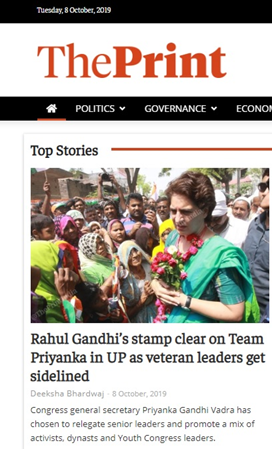
Not wanting to be left behind, Shekhar Gupta’s The Print tells us on October 8, that there is a “Rahul stamp” visible on “Team Priyanka”.
Congress, Pallavi Ghosh
The maze indeed gets murkier – we now have Team Sonia, Team Rahul, and Team Priyanka. And we have tough competition amongst the English media on who praised each of these teams the best. Perhaps rewards include a trip to Thailand?
It beats me as to how the Congress party still continues to think that today’s citizen will still buy lousy stories such as these. How does the Congress party not see the writing on the wall?

From Fani, Titli, Gaja, Kerala floods to Karnataka: Here is how the Modi government has responded to natural disasters


The following article was written for OpIndia. Pasting it here for reference

Starting with the Kerala floods of 2018, every time a natural calamity strikes, it has become almost fashionable to blame the Modi government for not giving enough money for disaster relief or at times, not even tweeting about the disaster! The WhatsApp group of “Self-declared Eminent Citizens” are typically at the forefront of spreading these rumours. At first, I did a cursory search in the Lok Sabha website and surprisingly found out that 1000s of crores of money was indeed given by the Central government to various state governments just in the past couple of years. Very curious, I dug further.
Under the Disaster Management Act, 2005, there are two kinds of funds set up exclusively for disaster relief – the National Disaster Relief Fund (NDRF) and the State Disaster Relief Fund (SDRF). In addition to maintaining the NDRF, the central government also used to contribute 75% of the funds of SDRF. So each state had to only contribute 25% to the SDRF (In the case of Special Category states, 90% came from the central government).
After the Modi government came into power, the total value of funds made available in SDRF for the period of the 14th Finance Commission (2015 to 2020) was increased from the previous INR 33,580 crores to INR 61,220 crores. That’s a startling 88% more money available for any kind of disaster relief. Additionally, starting April 1st, 2018, the Modi government has increased the centre’s contribution to the SDRF to 90%. Now, all states of the country get 90% of their SDRF funds from the central government itself.
The funds available in the SDRF are entirely at the disposal of the state government only. There is no need for the states to get the permission of the centre to use this money for all designated disasters. In case additional funds are needed, an Inter-Ministerial Team meets regularly to decide on how much to allot from the NDRF.
When the Kerala floods happened in August 2018, this WhatsApp group were at the forefront of this charade that while UAE was offering INR 700 crores for relief, our government had given only INR 600 crores. When the UAE offer turned out to be a big lie, this group went totally silent. And in December 2018, the centre released a whopping INR 3048 crores for the Kerala Floods. This is in addition to the INR 790 crores already available in the SDRF, and also in addition to many other things done at that time.
When the Titli cyclone hit the coasts of Odisha and Andhra Pradesh, the then AP CM, Shri N.Chandrababu Naidu was on the forefront of complaining that the centre was not giving him enough funds. Those were the days when he used to complain that the centre was not funding a new handkerchief each time he sneezes, but those were also the days when many people believed his propaganda. The cyclone hit the coast in October 2018. In addition to released INR 230 crores in October itself, the central government had given a total of INR 539.52 crores for Titli relief from the NDRF. Do note here that the state government already has INR458 crores in the SDRF, 90% of which came from the centre only! By the way, Odisha received additional assistance of INR 1023 crores from the NDRF for Titli relief measures.
Similar noise was made when cyclone Fani hit the coast and impacted AP, Odisha and West Bengal on April 2019. In a shocking move, Mamta Banerjee did not even talk to the PM when the PM himself called to assess the damage. Yet, advance assistance of INR 1086 crore was released to the three states. An additional INR 1000 crores were given to Odisha only after the PM visited the cyclone ravaged state. People who wanted to call this an election gimmick could not do so, for the simple reason that the cyclone hit Odisha and AP *after* the election was over!
When Cyclone Gaja hit Tamil Nadu, some usual suspects filed a case in the High Court. At that point of time, the HC was informed by the state government that the “Centre is yet to release 1000 crores”. Turns out that a total amount of 2177 crores was made available with the state government from the centre!
There was yet another outrage after the recent Karnataka floods. The centre has now released 1200 crores for rehabilitation efforts in Karnataka.
The expectation that as soon as calamity strikes, the central government should simply give as much money as is being demanded, is a totally unfair one. In all their responses to the various questions in the Parliament, the central government has a standard paragraph. It is important that we read it carefully (emphasis mine):
“Though the primary responsibility for disaster management rests with the State Governments, Central Government extends all possible logistics and financial supports to the States to supplement their efforts to meet the situation effectively. The concerned State Governments undertake an assessment of damage and provide financial relief in the wake of natural disasters including cyclone, from the State Disaster Response Fund (SDRF) already placed at their disposal. Additional financial assistance is extended from the National Disaster Response Fund (NDRF) by following the laid down procedure, which includes an assessment based on the visit of an Inter-Ministerial Central Team (IMCT).”
While we speak so much about money, there are many things that the Government of India provides as logistics support that doesn’t get counted into all the above amounts I have mentioned. Like the thousands of metric tonnes of relief material (Rice, water, milk etc); Like the helicopters/aircrafts the Indian defence forces have deployed; like the boats, the Navy deploys; like the occasional tax sops; like the additional trains run; like rebuilding the national highways and so on.
While it is indeed a fashion to blame Modi for everything, it is pertinent to note that the state governments usually tend to get away with this blame game. The state governments must be held more responsible for all the rebuilding efforts. With so much relief material that pours in from various parts of the country when disasters happen, what exact reason do the state governments have to not co-ordinate exemplary rebuilding efforts?
As for the lies propagated by the usual suspects, it is a shame that they simply dust it off when their cheap propaganda is pointed out.