The following article was written for MyInd Makers. Pasting it here for reference:
In December 2018, the Telangana Rashtra Samithi (TRS) party swept the Assembly elections by winning 88 out of the 119 seats. You would think that the party will be thrilled about this and would not need to worry about having to poach MLAs from other parties. Very mysteriously, TRS started to induct one Congress MLA after the other into their party, almost immediately after winning.
The Congress won 19 seats. From December 2018 to June 2019, 12 Congress MLAs joined the TRS, one after the other. One of the MLAs went on to become an MP, so the strength of Congress in the Assembly was 18. It was then that all the 12 MLAs went to the Speaker and “merged” the Congress Legislature party into the TRS. Why is the number 12 important here?
The anti-defection law prevents elected representatives from switching parties during their active term. The only exception being that if 2/3rds of your MLAs or MPs switch over. The law doesn’t state if all 2/3rds have to switch at the same time or can do one after the another. The law doesn’t define a timeframe for the Speaker or Chairperson of the House to decide. Using this loophole very conveniently, the then TRS party waited for 12 MLAs to join them and then the Speaker took an “expeditious” decision. Till date, it is baffling why KCR had to resort to this poaching when he didn’t need to do it.
In December 2023, the Congress party won the Assembly elections in Telangana. It won 64 out of the 119 seats. Its ally CPI won one seat. So, the Congress also doesn’t need to break the TRS (now BRS) to survive. However, the Congress party is following the exact strategy that the TRS followed back then. So far, 5 BRS MLAs have been inducted into the Congress party. In fact one of the MLAs who jumped back into the Congress party even contested on a Congress ticket for the Secunderabad MP seat.
The CM is openly telling that he will continue to break the BRS. There is active work going on that front. Former ministers and even the ex-Speaker has joined the Congress party after winning from the BRS, just 6 months back. Torchbearers of Democracy are silent on all of this. Upholders of the Constitution have suddenly forgotten that all of this is happening at the behest of Rahul Gandhi’s Congress. Probably under his guidance, who knows!
It is baffling how the Congress announces in its manifesto that it will bring a law to prevent poaching of elected representatives and poach them immediately after losing the elections. Actually, I take it back. It’s not baffling that the Congress is doing this. It is baffling that the loudest voices are stunningly silent on this chicanery of Rahul Gandhi.
Analysts in Telangana though have no love lost for the BRS. There is a unanimous opinion that the BRS is simply getting back their bad karma. The decimation of BRS in the Lok Sabha elections has certainly added to their woes and if their arrogant leadership continues on the same path, the decimation will be complete. However, this article is not about why BRS is faltering so badly.
It is about Rahul Gandhi’s theatrics of holding a book with a red cover that he claims is the Constitution of India and his reality of violating that very book time and again. Rahul Gandhi’s theatrics have been time and again rejected by the people of the country silently. The loudest voices though continue to hype his theatrics and ignore his real actions.
In Telangana, to break the BRS, the Congress party will have to poach 25 MLAs from BRS! The CM seems supremely confident that he will achieve this. If he does not, then there is a possibility that the court may intervene and call for elections of those who switched over. While politically, this makes for a good exciting future to look forward to, it also calls for a debate on Rahul Gandhi’s chicanery.
The following article was written for OpIndia. Pasting it for reference:
When Prime Minister Indira Gandhi
was assassinated in 1984, she was a member of Lok Sabha from the Medak
constituency in Telangana (then part of Andhra Pradesh state). The BJP won this
seat in 1999, when it was in alliance in TDP. The victor, Mr. A. Narendra, went
into TRS and won the seat again in 2004. And ever since, this seat has been a
TRS stronghold for 20 years. Medak was one of the two seats that TRS won in
2009. Medak was the seat from where KCR himself won in 2014 (and gave it up for
the MLA seat because he became the CM). KCR’s MLA constituency is also part of
the Medak Lok Sabha constituency. One can thus gauge the importance of this
seat in the annals of history.
True to their nature, voters of
Medak created new history in 2024 Lok Sabha elections he 2024 And for the first
time in history, the BJP won this seat on its own in 2024, thus creating new
history! The candidate, Mr. Raghunandan Rao is fairly well known and is the one
who won the all important Dubbaka Assembly by-election
in 2020 – an election that heralded the downfall of KCR! Mr. Raghunandan
Rao is no stranger to Medak. This is his home constituency and he has also been
the Medak in charge of TRS, back when he was a member of the TRS. All those
grassroot level contacts certainly played a crucial role in his stellar
campaign in this constituency. He was up against formidable forces but the
pro-Modi wave in Telangana coupled with some anger against incumbent Congress
party were used very well by him.
Medak is not the only
constituency in Telangana where history was made. India’s biggest Lok Sabha
constituency is Malkajigiri constituency in Telangana. Current Telangana Chief
Minister, Revanth Reddy, won this seat in 2019 Lok Sabha elections. In a way,
this was his sitting seat and with him winning the 2023 Assembly elections,
this seat was supposed to be an easy seat for the Congress.
BJP’s candidate, Mr. Eatala
Rajendar, won this seat by polling a whopping 53% of the votes! He is also no
stranger to the people of Telangana and infact has been a pillar for TRS until
KCR unceremoniously decided to sack him. Though he won the assembly
by-poll in 2021, he lost his seat in the 2023 elections only to make a
great comeback in the 2024 Lok Sabha elections!
Mahbubnagar constituency also
witnessed another scintillating contest in which the BJP candidate, Mrs.
D.K.Aruna won by a slender margin of ~4500 votes! KCR himself won from here in
2009 (in alliance with the TDP and Communists). Current Telangana Chief
Minister from Congress, Revanth Reddy’s assembly constituency forms a part of
Mahbubnagar Lok Sabha Constituency too! No wonder this was touted as a very
tough seat right from the beginning. Nevertheless, one of BJP’s national Vice
Presidents, Mrs. D.K.Aruna put up such a spirited fight that the BJP wrested
this seat too.
One of the most unique
constituencies in Telangana (and perhaps India) is the Chevella constituency.
It ranges from the famed Hi-Tech city of Hyderabad to interior villages in
Vikarabad – making it a really unique combination of pure Urban and pure Rural
populace! BJP’s candidate, Mr. Konda Vishweshwar Reddy is a highly accomplished
entrepreneur; comes from a highly respectable family; is married into a highly
respectable family; has been an MP in 2014 from TRS; and has now won it for a 2nd
time in 2024, from the BJP.
In addition to these 4 seats, the
BJP has also retained 4 seats it won in the 2019 elections – Adilabad,
Karimnagar, Nizamabad and Secunderabad. The party was in near doldrums during
the 2023 elections. It won only 8 Assembly seats out of the 119 seats. Too many
unsavoury happenings in late 2022 resulted in unexpected changes at the helm in
the state. There was not enough time to salvage the 2023 result but under the
stewardship of Mr. Kishan Reddy, the party was able to bounce back in the 2024
Lok Sabha, producing a stellar result! A combination of very good candidate
selection; early announcement of all candidates; and great campaign that added
to the Modi-wave in the state enabled BJP to win 8 and come 2nd in 7
seats!
The Congress party was hopeful of
winning 12-14 seats, riding on their victory just 6 months back in the assembly
polls. However, a combination of unfulfilled
promises and a very strong resurgence of the BJP ensured that they win 8
seats.
The second biggest story though,
is the decimation of the BRS. They won 0. From being a ruling party just 6
months back to scoring a nought – the downward spiral was perhaps not
surprising, given how the party reacted to the loss in the Assembly elections. Not
a single lesson was learnt by the leadership. KCR, injured from a fall at his
home, didn’t go to the Assembly at all – leaving it to his son and nephew to do
all the firefighting. KCR’s son, KTR, continued to exhibit unparalleled
arrogance (the same that led to the loss in the first place) in his speeches
and interactions. KCR didn’t even issue a statement when his daughter, Kavitha,
was arrested in the Delhi Liquor scam case. He was quick to release a statement
when Kejriwal was arrested though. Actions like these
didn’t obviously go well with the people. The cadre was very quick to desert
the leadership – resulting in a whopping drop of 24% vote share!
BJP, which was primed to rise as
the second major party in the run-up to 2023 elections lost steam closer to the
elections. It is now again in the same position. The national leadership should
not let this current position of strength to slip like last time. The people’s
faith in the BJP must be taken forward in Telangana, for a replication of
Odisha situation!
The following article was written for MyInd MakersMyInd Makers. Pasting it here for reference:
On June 8th, 2024 we woke up to the news of the passing away of Ramoji Rao. I was immediately reminded of a tweet I posted in the year 2013 about how Ramoji Rao had a profound daily impact on pretty much every Telugu family for nearly 3 decades through the many companies he ran.
For many decades, his newspaper, Eenadu, that translates to “Today”, was part of a daily routine of lakhs and lakhs of families. The decent language the paper used; the different sections that the paper introduced so that they can cater to various sections of the audience; the Sunday book (that is still a rage amongst the Telugu audience!) – all have endeared the newspaper very much to households across the state. His open support to the Telugu Desam Party ever since the launch; his support to Chandrababu Naidu during the coup against NTR; his vitriol against YSR – all of these have failed to mark a big dent in the popularity of the newspaper. It is really no wonder that Eenadu has remained the largest circulated Telugu newspaper for decades now.
Ramoji Rao’s advent into the television industry was also equally game-changing. For decades, ETV has retained a fan base that any other channel would be envious of. ETV has turned news-reading into an art; and their 9pm news continues to remain as popular today as it was when they launched is nearly 30 years back. There are no cacophonous discussions on ETV; there is just simply news delivered in a packed 30 minutes with excellent language (biased, ofcourse, but that isn’t the point of this article). Watching the 9pm news on ETV is still a routine that many families in the Telugu states follow.
ETV produced and hosted the most popular music reality show – Paaduta Teeyaga – roughly translates to “I will sing sweetly”. Frankly, to lakhs of families, this was not a reality show. It was an emotion. We all know how much drama is unnecessarily added to music reality shows today. Paaduta Teeyaga was the complete opposite of that concept. Hosted by the indominatable S.P.Balasubramaniam, it still continues to evoke the same emotion as it did when they started it. SPB himself has mentioned the role Ramoji Rao played in the formation of this program. On similar lines, Ramoji Rao’s team designed another musical show – Swarabhishekham – where every Sunday evening, a 3-hour musical extravaganza lay in store for the audience. Music legends, directors, producers, heroes etc were invited and their songs were performed on stage and then honoured. Lakhs of families were glued to this program, come Sunday evening, for many years!
Likewise, there are many such programs that ETV not just pioneered but became a part of household viewership and family bondings. Such bondings happened only with Doordarshan before, and perhaps Star TV for a brief while. In contrast, ETV continues to remain a channel that the entire household will happily sit and watch together.
Years before establishing the newspaper Eenadu, Ramoji Rao established Margadarsi Chit Fund company. It was against this company that the YSR government filed a criminal case against (in his first term), trying to bring the empire down. As an aside, even before social media came into existence, lines from ads of Margadarsi were very popular amongst common folks!
Ramoji Rao also established Usha Kiran movies and produced some really good movies on this banner. This production house wasn’t producing movies frequently, but has produced award-winning movies. Once ETV came to life, the production house slowly moved into producing serials.
Ramoji Film City is yet another fantastic feather in his cap.Today, almost every family either visited it or wants to visit it atleast once. Hundreds and hundreds of movies have been produced by various language industries in Ramoji Film City. The contribution of the Film city to film making in India is simply extraordinary.
A lesser-known aspect of Ramoji Rao’s empire are the Priya pickles! Yet again, lakhs of households have some Priya pickle or the other that forms part of their kitchen.
While there are ofcourse many big business empires that create products and make life easy, there are a very few empires that become part of your routine in life. Reading and discussing the Eenadu paper was one such routine for lakhs of families. Watching programs on ETV with the entire family gathered around it, was another such routine. A picnic to Ramoji Film City is another memory many families have added to their lives. Ofcourse, Ramoji Rao is not a perfect person. But it would be unwise to reduce his legacy to the happenings of the past few years. He has created something that has impacted generations in the Telugu states. And for that, hope he travels well into a different world now.
The following article was written for OpIndia. Pasting it here for reference:
In the run-up to
the Assembly elections of Telangana, the Congress announced 6 guarantees for
the people of Telangana. As elections started nearing, Revanth Reddy repeatedly
promised that he will implement ALL guarantees within 100 days of coming to
power. The conviction in his tone was believed by the people of Telangana
and they voted the Congress to power.
First of all,
what are these 6 guarantees? Below is a variant of the info-graphic that
Congress used in all newspaper ads and all their official handles.
It is a very well-designed
info-graphic that gives you the first impression that there are actually only 6
guarantees in the promise. A second look and you will realise how the Congress
scammed you even with something as simple as a number! A closer perusal of the
document shows that the actual guarantees being promised are 13 in
number, and not 6! Almost every “Guarantee” has sub-guarantees also included in
them.
·Guarantee # 1 is titled Mahalakshmi, and has a
total of 3 sub-guarantees.
·Guarantee # 2 is titled Rythu Bharosa, and has a
total of 3 sub-guarantees.
·Guarantee # 3 is titled Yuva Vikasam, and has a
total of 2 sub-guarantees.
·Guarantee # 4 is titled Indiramma Indlu, and has
a total of 2 sub-guarantees.
·Guarantee # 5 is titled Gruha Jyothi and is the
only guarantee with no sub-guarantees!
·Guarantee # 6 is titled Cheyutha, and has a
total of 2 sub-guarantees.
It is now very
clear that Revanth Reddy wanted to get away with implementing any 6 out of
these 13 Guarantees within 100 days and claim that he kept his promise. I must
say, it was a very innovative way of doing a scam! Now, let’s take a look if he
actually executed this intelligent scam. The Congress government completed 100
days on March 17th, 2024. The election code kicked in on March 16th,
2024. In the above info-graphic:
Guarantee
(1) has 3 sub-guarantees.
The
2500/- per month to every woman scheme, has NOT been started at
all.
Oher
2 Sub-Guarantees are being implemented.
Guarantees
number (2) and (3) have NOT even started.
Guarantee
(4) has 2-sub guarantees.
The
“250 sq.yards plot for all movement fighters” has NOT been
initiated at all.
The
“House site and 5 lakh for people not having own house” is only PARTIALLY
started now (announced only in the 1st week of March for a
limited set of people)
Guarantee
(5) has been announced and is being implemented from March 1st.
Guarantee
(6) has 2 sub-guarantees.
The
“4000 rupees monthly pension” has NOT been started at all.
The
increase in health insurance was perhaps the easiest one to implement and
is under implementation now
So, that
essentially means that only 4 out of the promised 13 guarantees (in 100
days) are currently fully being implemented. If you want to give credit for
an additionally partially implemented promise, then Congress is implementing
only 4.25 out of the promised 13 guarantees! Let’s for a moment not even delve
into this much detail and just go by the slogan “6 Guarantees” that were
promised in 100 days. Even amongst those, only 4 are being implemented which is
a clear breaking of the vehement promise Revanth Reddy gave before the
elections.
Outside of these
6 Guarantees, Revanth Reddy also promised a loan waiver program for the
farmers, again within 100 days. Caught openly with this lie, Revanth Reddy now
promised a new date for only this promise – August 15th!
Caught in a
quagmire over his unkept promise, Revanth Reddy is using a new strategy. He is
openly threatening people
that if they don’t vote
for the Congress party in the 2024 Lok Sabha elections, then it will be
very difficult for him to provide these “guarantees”. It is a really strange
argument but it is also not surprising because this has been the Congress DNA –
to threaten voters with dire consequence for trusting them in the first place. The
voters trusted Revanth Reddy when he said he will fulfil ALL guarantees within
100 days. Voters are obviously angry that he did NOT keep his promise. Instead
of apologising to them, Revanth is threatening them that if they don’t vote for
Congress, they will not get the other guarantees too!
Revanth Reddy
has been constantly claiming that the Lok Sabha election is a referendum
on his 4-month rule. The media also went gaga over him and his working
style. Revanth Reddy is also going national, with his appearances on various
channels, and is eloquently explaining Rahul Gandhi’s divisive agenda in these
interviews! The hard reality is that the Congress has yet again cheated people
with false promises and is now threatening the very same people with dire
consequence. Afterall, old habits die hard!
The following article was written for OpIndia. Pasting it here for reference:
As hard as it is to believe, we
were actually able to write 9 articles in a series titled How Prime Minister
Modi hacks EVMs (all listed at the end of this article) without even touching
upon the huge and epochal events that have unfolded in his 10 years as PM. The
scale of his trail-blazing
decisions is very large. Even after 9 articles on various topics ranging
from health to wealth, from law-making to peace-making, we still haven’t
touched upon the many other decisions that look seemingly small but are infact
big.
For example, that the Modi
government changed the eligible age for marriage to 21 years for both men and
women? Did you know that nearly 2000 old rules
and laws that were obsolete were removed by the Modi government? There are
many such more small things that we can spend time on (A twitter
thread here talks about 175 unique accomplishments), but we should move on
to discuss the events and decisions that no one thought was possible to
achieve, but that this government has accomplished!
The opening of the new
Parliament building, while a big event in itself, was also a witness to two
huge events in Independent India. In 1947, just before the transfer of
power from British to India, Jawaharlal Nehru was presented with a Sengol from
Tamil Nadu, that will signify the transfer of power. Jawaharlal Nehru sent it
to a museum and it was later classified as his walking stick! It took Prime
Minister Narendra Modi’s initiative to restore the Sengol to its rightful place
in the Lok Sabha. This powerful image of India’s Prime Minister walking with
the Sengol, accompanied by the chanting of mantras by the pandits, has left
a really lasting impression in my mind.
The Women’s Reservation Bill
was passed in the first session of the new Parliament building. A bill that was
first mooted in 1996 could only become law in the year 2023. This was passed
with an unbelievable 454-2 majority in the Lok Sabha. The scale of this
achievement will be visible (literally!) once we see 33% of our
parliamentarians being women, post the delimitation exercise. Both the events
are befitting the stature of the event of opening of the new Parliament
building.
The National Education Policy
has been revised for the first time after 1985. This NEP is even more
transformational than the 1985 one. The current 3-tier structure in our schools
will be changed to a more meaningful 4-tier structure; there is going to be
increased focus on funding of research in our colleges; there are going to be
changes in the way degrees are awarded; we now have the choice of making
education more flexible (such as breaking up a degree into multiple slots). A
single paragraph or a single article cannot do justice to discuss the
monumental changes NEP will bring in once it becomes fully operational.
The Presidency of G20 was
ridiculed by the opposition saying that this is just a rotating feature and
nothing great about Modi. It’s phenomenal how they underestimate Modi when they
ridicule him on matters so big! Nearly 200 programs related to the G20 were
held in more than 60 cities or towns in entire India. It didn’t matter which
party was ruling a particular state – all states got good preference in hosting
multiple leaders from the most powerful countries of the world in their cities
or towns. Celebrations were seen in the cities and towns that hosted these
multiple summits.
The first big pleasant surprise
came when we all saw our Prime Minister PM Modi addressed the G20 Summit with
‘Bharat’ nameplate.
The second pleasant surprise was
equally very heartening. G20 was made more inclusive when the 55-member African
Union joined the grouping – something that no one imagined. Just when they
thought there will not be any more surprises, came two more big announcements.
One is the establishment of the India-Middle East-European economic corridor.
And the other was is the establishment of the Global Biofuels Alliance.
This
OpIndia article captures very well the 10 huge accomplishments of the
transformative nature of our G-20 Presidency. By involving all states of India,
Modi didn’t make G20 the elitist event they thought it was. By getting the
African Union to join G20, Modi made sure G20 isn’t an elitist organisation
they thought it was. The Presidency may have gone to another country via
rotation, but the legacy of what India achieved in its presidency will stay
forever!
There came a time when no one
took political party manifestos seriously. That was because everyone just
thought all political parties lie on their manifestos and nothing really ever
comes out of it. All that changed on August 5, 2019. Words fail to
describe the emotions one was undergoing while watching the political acumen
with which Article 370 was abrogated on that day in the Rajya Sabha and
the next day in the Lok Sabha. The ensuing peace and prosperity in Kashmir that
followed the abrogation is ample proof of how people have
lapped up their new found freedom. It is baffling how people of J&K
were deprived of all the opportunities
available to the rest of the country and yet their misery was sold to us as
a normal occurrence in J&K.
The pran prathista (I
cannot find an English translation that will sound as beautiful as this!) of
Bhagwan Ram in the magnificent Ram Mandir at his birth place in Ayodhya, is a
truly epochal event. The epochal scale is evident from the fact that it took
more than 500 years for this to happen.
The Prime Minister delivered a
brilliant speech that befit this occasion. After most eloquently describing
what Prabhu Ram stood for, Prime Minister Modi also reminded us of our duty to
now lay the best possible foundation of a Bhavya Bharat for
the next 1000 years. He has reminded us of the hope and aspirations that
this new era brings to the crores of Indians. And he has guided us on how we
must conduct ourselves to fulfil this responsibility of transforming our
country. He has himself led by example and made us all his partners in the
transformation so far. The work is far from finished though. We built
a Bhavya Mandir. We will now build a Bhavya Bharat!
This brings to end the 10-article
series on how Prime Minister Modi hacks EVMs. Part-1 speaks
about the focus on small-scale entrepreneurs; Part-2 speaks
about the revolutions in the labour/employment sector; Part-3 speaks
about the focus on both prevention and cure in health; Part-4
speaks about how the lives of women were made better at home, school and work. Part-5
speaks about the Focus on financial systems, along with Big Bang Reforms and
simultaneous benefits to middle-class, economically weaker sections. Part-6
speaks about law-making and peace-making efforts that made India a much safer
place to live in. Two articles, not numbered in this series, but count into how
he hacks EVMs are – The
many highs of the 17th Lok Sabha; and the implementation
of the AP Reorg Act. And of course, this particular article 😊.
The following article was written for OpIndia. Pasting it here for reference:
Urea as a fertilizer is widely
used and because of this, it was also one of the highly pilferaged fertilizer
in the country. There was a time in our country when farmers had to stand in
long lines to buy Urea. The long lines often led to fights and occasionally led
to even the police having to get involved. Urea that was supposed to land in
the hands of the farmer, often ended up with chemical industries or even rogue
elements that used Urea to prepare adulterated
milk.
What was the solution for this?
Neem coating the Urea. This will increase its yield and also make it unusable
for pilferage. In the year 2002, when
NDA was in power, it was recommended that Urea be neem-coated and the same was
experimented at one plant. It took about 2 years for us to understand it’s
success at a small scale. The decision to expand this to large scale was to be
taken in July 2004. Mysteriously, very mysteriously, the then UPA government
led by the honest Manmohan Singh decides to only neem-coat 35% of the Urea! It
doesn’t take a genius to figure out why this was done. After becoming the Prime
Minister of India, Narendra Modi made neem-coated Urea as 100% mandatory! I now
don’t need to explain the immense benefits that our farmer got because of this
one decision. So, we just have to ask ourselves why the farmer will not press
the lotus button on the EVM?
Urea is not the only input needed
for a good crop. Farmers will need to spend some money to buy equipment year
after year. It took someone like Narendra Modi to come up with a unique scheme
called Kisan Samman Nidhi. The scheme will transfer, directly to the farmers
account, 6000 rupees per year in three equal instalments. Many state
governments have attached themselves to this scheme and add some more amount.
Therefore, crores of eligible farmers now get upto 10,000 rupees per year from
the government, that they can use as Input credit. Till date, nearly a whopping
2.5 lakh crore rupees has been transferred to over 11 crore accounts as
Input credit. Now, ask for yourself, why would they not credit Narendra Modi for
their prosperity and press the Lotus button on the EVM?
Speaking about Inputs, one of the
biggest inputs that a farmer will need is about the health of the soil. By
issuing nearly 23 crore Soil Health Cards (a unique initiative), the
Modi government has ensured that farmers are aware of the strengths and
weaknesses of their soil and will take decisions accordingly!
For most people in the organised
sector, having an insurance is a very common thing. For farmers, it was a
nightmare to have insurance for their crops. In 2016, with the launch of the PM
Fasal Bima Yojana, the Modi government fulfilled yet another long pending
demand from the agricultural community. Did schemes not exist before 2016?
Ofcourse yes. The premium was high, coverage was low and settlement was a
nightmare! After resolving these critical problems in 2016, the Modi government
bought in further reforms to their own scheme in 2020. The speed with which
feedback is incorporated into schemes is a topic for another article! Today,
nearly 30 crore farmers across the country have insured their crops under this
scheme. Nearly 95,000 crore rupees have been paid by the government to
the farmers on their claims! 95,000 crore rupees!
When Prime Minister Modi
announced that his government’s aim is to double the farmer’s income by the
year 2022, many mocked him. They mocked him because they wanted statistical
proof of doubling of income from every farmer in the country. They were so busy
mocking him that they lost sight of the many schemes that were being
implemented by him. Today, Milk production in India is nearly 50% more than
what it was in 2013! Today, there has been a more 50% increase in the
production of pulses compared to 2013 (Infact, notice
the stagnation in the production of pulses for a large part of UPA). I can
go on and on about the increased production in various agricultural products
but you get the picture! There was so much noise around giving MSP a legal
status, while all along the Modi government increased MSP on multiple products
thereby increasing the income of the farmers. Our farmers are producing more
and earning more because of the government’s schemes, then is it any surprise
that they will opt to press the lotus button
Agriculture is not just about the
food grains. Through the PM Matsya Sampada Scheme, nearly 6 lakh fisher
families get livelihood and nutritional support in their lean fishing periods;
and heavy investments into fishing-related infrastructure. All these have led to
India becoming the 2nd largest fish-producing country. I think
you now understand how these lakhs of families will willingly become part of
the project where they will go and press the relevant button on the EVM, come
election day!
Today, our farmers produce more
than before. Our farmers sell more than before (e-NAM is a brilliant example). And
most importantly, our farmers earn more than before. Agriculture, Aquaculture,
Diary-culture etc are thriving like never before. Now, ask for yourselves, why
would these crores of farmers not come out on election day and press the lotus
button on the EVM?
This is the 7th article
in the series Decoding How PM Modi hacks EVMs (an allegation the opposition
often throws at him). Part-1 speaks
about the focus on small-scale entrepreneurs; Part-2 speaks
about the revolutions in the labour/employment sector; Part-3 speaks
about the focus on both prevention and cure in health; Part-4
speaks about how the lives of women were made better at home, school and work. Part-5
speaks about the Focus on financial systems, along with Big Bang Reforms and simultaneous
benefits to middle-class, economically weaker sections. Part-6
speaks about law-making and peace-making efforts that made India a much safer
place to live in.
The following article was written for OpIndia. Pasting it here for reference:
In very eloquent language,
editors of the English Print media used to often write on the need to withdraw
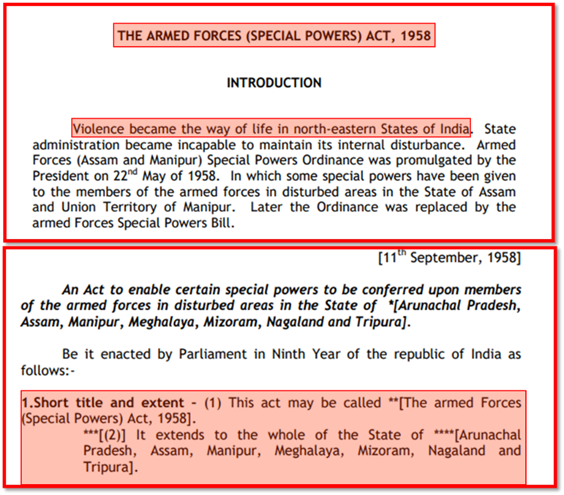
the Armed Forces Special Powers Act 1958, known as AFSPA. This act was termed
draconian because of the powers it gives to our Armed Forces (Kill anyone,
arrest anyone etc) in areas where it is implemented.
The 1958 Act begins
by saying “Violence became the way of life in north-eastern States of
India”.
The Act was supposed to be
implemented in 2 states. And then the successive Congress governments have
increased the scope of this act to all 7 states in the North-East, and then
Punjab and then Jammu & Kashmir! Instead of taking the Congress governments
to task for worsening law & order, our English media made it sound like we
have no other option. Until 2014.
The Narendra Modi government
showed unparalleled focus in bringing peace to the North East. A gradual
withdrawal of this Act was facilitated with some real hard work behind the
scenes to improve the situation in the North East. The net result is that today,
only a handful of districts in the entire 7 states still have the AFSPA.
Meghalaya and Tripura are completely out of AFSPA.
Many of us grew up reading about
the dreaded ULFA from Assam. ULFA was responsible for many deadly militant
attacks. It was only in the year 2023 that a final peace settlement was
reached. Today, the North East has become a beacon of development. The peace
and infrastructure development over the past 10 years has opened up hitherto
unknown prosperous opportunities for the people of this region. Violence is no
more the “way of life in North-Eastern States of India”. Is it therefore any
wonder that the North East will overwhelming press the Lotus button on the EVM?
A term “Red Corridor” was coined
to highlight the massive influence the violent Naxalite movement was having in
our country. Nearly 180 districts in 10 states were part of this “red
corridor”. The dreaded Naxal problem was born because of the Congress rule. The
dreaded Naxal problem peaked during the Congress rule. In 2006, Manmohan Singh termed
the Naxal problem as the “single biggest internal security challenge ever
faced by our country”.
In addition to the violent
attacks on our police forces and fellow citizens, Naxal idealogues also occupied
prime space in our print and TV media, making us believe that this violence is
totally justified. Despite calling it as the most serious security problem, UPA
really didn’t do anything to solve it. Just in the year 2010, we lost 1005
police + civilian people lost their lives
. Contrast that to the 98 lives lost in the year 2022 and ask for yourselves,
if our country is now a safer place to live or not!
We still haven’t forgotten those
miserable UPA years when many cities used to get attacked by terrorists. From
2004 to 2014, almost every state of India was attacked by terrorists and nearly
1200 of innocent civilians of our country lost their lives in Ayodhya,
Delhi, Ahmedabad, Mumbai, Hyderabad, Varanasi, Pune, Malegaon, Dimapur,
Ludhiana, Lucknow, Jaipur, Guwahati, Agartala, Imphal, Srinagar, Patna and
more.
Ever since Narendra Modi became
the Prime Minister, the number of terrorist attacks outside of the problematic
areas of Jammu & Kashmir was near 0. The number of civilian deaths are
perhaps in the single digits. During the UPA days, we were made to believe that
terror attacks will happen despite good security and the people of this country
should just accept this as a way of life. The then Home Minister P. Chidambaram
even told us something to the effect that “terrorists only have to succeed
once. Police have to succeed always”. In a total reversal of the situation,
Narendra Modi government’s exemplary focus on intelligence gathering and
prevention of attacks certainly saved 100s of lives in India.
Law and Order is perhaps the most
difficult ministry of all. Despite such great focus, we still had to witness
Naxal attacks on our police force, unrest in Manipur and violence in J&K.
The abrogation of Article 370 has certainly made Kashmir a safer place than
before. If statistics are of any indication, then it is clear that it is only
the Narendra Modi government that will make this a much safer place in the
years to come.
India’s 3 biggest problems –
terrorism, insurgency and naxalism – have all seen great decline in just the 10
years of Narendra Modi government. It’s also not just about working on the
three biggest problems. A robust approach on areas such as drugs for example -
A record 72,00,000 kgs of drugs were destroyed by this government! Is it
therefore any wonder that citizens who feel much safer now, will overwhelmingly
press the Lotus button on the EVM?
Our
movies made IPC section 302 and IPC section 420 very popular. While many movie
goers would have been aware that IPC stands for Indian Penal Code, they would
not have been aware that IPC was first enacted in the year 1860! That’s right -
up until the year 2023, we just used the
law that was drafted 163 years back! Yes ofcourse it was amended from time to
time, but the basic structure remained outdated; many laws in the code became
obsolete and modern times demanded a modern law in tune with not just the times
but with our country too!
In
the year 2023, the Narendra Modi government replaced the IPC(1860), with a new
act – the Bharitya Nyaya Sanhita 2023. The government also replaced the Indian
Evidence Act 1872 (!) with the Bharitya Sakshya Adhiniyam and the Criminal
Procedure Code (CrPC) 1974 (first enacted in 1898!) with the Bhartiya Nagarik
Suraksha Sanhita, 2023!
Many articles have been written
about how many
outdated provisions were removed and many new crimes got added to the law. The
removal of sedition; the de-criminalising of gay sex; the introduction of many
safety provisions for women in particular; the abolition of Triple Talaq; the
defining of new crimes – these and many more law-making reforms should infact
satisfy the woke crowd too!
From law-making to ensuring great
peace, the Narendra Modi government has certainly made India a safer place
compared to above. Is it therefore any wonder that crores of citizens will
press the button on lotus on the EVM, come election day?
This is the 6th article
in the series Decoding How PM Modi hacks EVMs (an allegation the opposition
often throws at him). Part-1 speaks
about the focus on small-scale entrepreneurs; Part-2 speaks
about the revolutions in the labour/employment sector; Part-3 speaks
about the focus on both prevention and cure in health; Part-4
speaks about how the lives of women were made better at home, school and work. Part-5
speaks about the Focus on financial systems, along with Big Bang Reforms and
simultaneous benefits to middle-class, economically weaker sections.
The following article was written for OpIndia. Pasting it here for reference:
Many big economies globally have maternity leave policy of a minimum of 3 months only. So, when my colleagues and friends in global organisations come to know that India has a mandatory 6-month maternity leave policy, they are still pleasantly surprised. As important as this reform is for women in the organised sector (bought of course by the Modi government), there was another scheme by the Modi government that caught my attention – the Pradhan Mantri Matru Vandana Yojana.
The unorganised sector, such as agriculture, for example, has lakhs of women in rural and urban India where they have to work right up to the last days of pregnancy and resume working very soon after childbirth. They typically don’t have the luxury of a 6-month paid leave. The nature of the work also takes a toll both on their health and that of the baby.
Through the Matru Vandana Yojana, the Modi government started a direct benefit transfer (DBT) scheme under which “cash benefits are provided to pregnant women in their bank account directly to meet enhanced nutritional needs and partially compensate for wage loss”. Coupled with the POSHAN Abhiyaan (that emphasises the nutritional status of adolescent girls, pregnant women, lactating mothers, and children from 0-6 years of age), a holistic support system has been developed for pregnant women & lactating mothers, in the unorganised sector!
While nutrition efforts were done earlier too, the direct cash transfer to also compensate for wage loss will bring in mental peace that cannot be quantified. Efforts such as these have improved the Maternal Mortality Rate from 132 per 1 lakh births to 97 per 1 lakh births. Now, you just have to ask yourselves why these women wouldn’t press the lotus button on the EVM
While we are on the topic of pregnancy, the upper limit for termination of pregnancy has been increased from 20 weeks to 24 weeks. This is important because certain abnormalities can only be detected after 20 weeks, and therefore gives a medical option to terminate if necessary. While we continue on the topic of pregnancy, did you know that India did not have any law governing Surrogacy? Modi government is the first government to enact a law that lays down rules for both Surrogacy and Assisted Reproduction. This may not fetch votes yet but lawmaking is the first step to help prevent the exploitation of women (especially for Surrogacy).
In the unorganised sector, the participation of women in the workforce is much higher than in the organised sector. Women constitute nearly 57% of the popular MNREGA program (Mahatma Gandhi National Rural Employment Guarantee Act). An International Labour Organisation study has pointed out how India improved the gender pay gap in MNREGA itself, over the last 8 years. We have already discussed how the Modi government revolutionised MNREGA with excellent high funding. So, in summary, more women participate in MNREGA; they earn more money now than before; they earn equivalent to men unlike how it was before. Now, you just have to ask yourselves why these women wouldn’t press the lotus button on the EVM!
In the unorganised sector, the participation of women in entrepreneurial ventures is also higher than in the organised sector. Nearly 10 crore rural women are part of nearly 1 crore Self Help Groups. However, with Prime Minister Modi, it’s never about maintaining the status quo. From the ramparts of the Red Fort on August 15, 2023, he has announced the aim of creating 2 crore lakhpati didis from these groups. While announcing these, the Prime Minister has also spoken about skilling them even in the latest technologies such as drone repairing, and LED bulb making so that they aren’t far off from technology. The concept of the scheme is simple – make these women lakhpatis!
An endearing conversation with one such lakhpati didi gives a great glimpse of why these women feel so comfortable talking to the Prime Minister of India. The rural women have bought into the concept of thinking big and achieving big, and are now fully in tandem with the Prime Minister’s vision. Another conversation with women diary entrepreneurs of Varanasi is another proof of how big a hit he is. Now, you have to ask yourselves why these women wouldn’t press the lotus button on the EVM!
With so much money coming in, where would the women keep all this money? Gone are the days of hiding money at home, away from the prying eyes of others. The amazing success of the Jan Dhan Scheme means that all these women have their own bank accounts (Out of the total 51.80 crore accounts, 28.75 crore accounts are owned by women!) and therefore access to their own money in the safest manner possible.
Rural women are also now able to spend more time working (either as entrepreneurs or employees) because they now have to spend less time worrying about one basic necessity in their house – drinking water. We all have read about and also seen how women have to endure scorching conditions and walk long distances to get drinking water for their home, or we have witnessed the fights that break out at the water tanker that comes to your village. The Jal Jeevan Mission (the slogan is catchy – Har Ghar Nal se Jal) now ensures every house must have a tap and 55 litres of water supply every day. Nearly 12 crore households out of eligible 19 crore households have already been provided this connection. Now, you just have to ask why these women wouldn’t press the lotus button on the EVM!
Speaking of their homes; Swach Bharat has ensured toilets have been built, thus making it safer for women in rural areas; electricity availability is not a problem; electricity bills are also reduced through LED bulbs in the Ujala Scheme; cooking is through gas cylinders and not through inhaling dangerous smoke from wood (10 crore connections so far, through Ujjwala Scheme!) – I mean, I can go on and on, but do you see how holistic the focus on improving the lives of women, at home and at work, has been?
Through Beti Bachao, Beti Padao, our sex ratio at birth has improved from 918 in 2014-2015 to 933 in 2022 (meaning more girl children are born now or lesser girl children are being aborted now, as compared to before). Not only are more girl children studying now, but even the last barriers to their education have now been removed (Did you know that Sainik Schools didn’t allow admissions to girls? That rule was removed in 2021 by the Modi government).
The legal age for girls to get married was 18. It has now been changed to 21, on par with men. Can you imagine the possibilities this opens up for the girls to pursue education and careers of their choice? Where will they get the money, you ask? The answer lies in the Sukanya Samriddhi Scheme – a parent opens an account for the girl child and can deposit up to 1.5 lakhs every year until she is 21 years of age. The account gets ~8% interest every year; the girl can withdraw 50% of the amount when she reaches 18, for higher education purposes. After she reaches 21, the entire money is hers. And already 3 crore accounts are opened and have deposited 1,62,000 crores of money into this scheme! And then there are the small things that matter big – for example, including victims of Acid attacks into the divyang category so that they get benefits meted out to the physically handicapped.
Not too long ago, we used to discuss the multi-fold problems that girls and women face in our country. There is perhaps no other government that has had such a holistic approach to improving the lives of women – at home, at school, and at work. And with the passing of the Women’s Reservation Bill in Parliament, we will now have 33% of women participation in law-making too. Now, ask yourselves again why crores of women wouldn’t press the lotus button on the EVM!
This is the 4th article in the series Decoding How PM Modi hacks EVMs (an allegation the opposition often throws at him). Part-1 speaks about the focus on small-scale entrepreneurs; Part-2 speaks about the revolutions in the labour/employment sector; Part-3 speaks about the focus on both prevention and cure in health.